Note
Go to the end to download the full example code.
2.2.7 Klein-Gordon equation
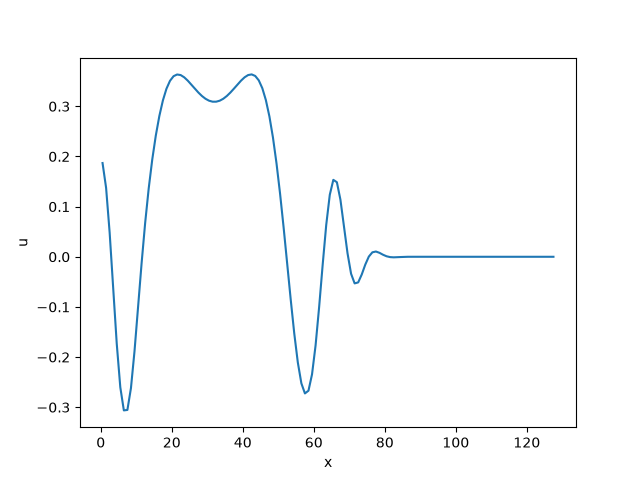
This example solves the Klein-Gordon equation in one dimension, showing the effect of the mass term on wave propagation. With mass=0 the equation reduces to the standard wave equation; increasing the mass introduces dispersion.
  0%|          | 0/50.0 [00:00<?, ?it/s]
Initializing:   0%|          | 0/50.0 [00:00<?, ?it/s]
  0%|          | 0/50.0 [00:03<?, ?it/s]
  0%|          | 0.01/50.0 [00:03<4:19:18, 311.23s/it]
  1%|          | 0.39/50.0 [00:03<06:35,  7.98s/it]
 53%|█████▎    | 26.66/50.0 [00:03<00:02,  8.56it/s]
 53%|█████▎    | 26.66/50.0 [00:03<00:02,  8.55it/s]
100%|██████████| 50.0/50.0 [00:03<00:00, 16.04it/s]
100%|██████████| 50.0/50.0 [00:03<00:00, 16.04it/s]
from pde import KleinGordonPDE, ScalarField, UnitGrid

grid = UnitGrid([128])  # generate grid
u = ScalarField.from_expression(grid, "exp(-((x - 32) / 5) ** 2)")

eq = KleinGordonPDE(speed=1, mass=0.5)  # define the pde
state = eq.get_initial_condition(u)
result = eq.solve(state, t_range=50, dt=0.01)
result[0].plot()
Total running time of the script: (0 minutes 3.239 seconds)