Note
Go to the end to download the full example code.
2.4.6 Custom Class for coupled PDEs
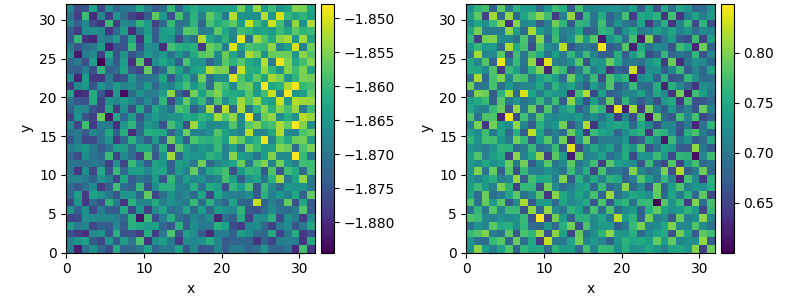
This example shows how to solve a set of coupled PDEs, the spatially coupled FitzHugh–Nagumo model, which is a simple model for the excitable dynamics of coupled Neurons:
\[\begin{split}\partial_t u &= \nabla^2 u + u (u - \alpha) (1 - u) + w \\
\partial_t w &= \epsilon u\end{split}\]
Here, \(\alpha\) denotes the external stimulus and \(\epsilon\) defines the recovery time scale. We implement this as a custom PDE class below.
  0%|          | 0/100.0 [00:00<?, ?it/s]
Initializing:   0%|          | 0/100.0 [00:00<?, ?it/s]
  0%|          | 0/100.0 [00:00<?, ?it/s]
  0%|          | 0.28/100.0 [00:00<00:46,  2.12it/s]
  1%|          | 1.05/100.0 [00:00<00:16,  6.15it/s]
  5%|▍         | 4.98/100.0 [00:00<00:07, 13.56it/s]
 14%|█▍        | 13.84/100.0 [00:00<00:05, 17.13it/s]
 27%|██▋       | 27.19/100.0 [00:01<00:03, 18.38it/s]
 43%|████▎     | 43.48/100.0 [00:02<00:02, 18.98it/s]
 62%|██████▏   | 61.56/100.0 [00:03<00:01, 19.27it/s]
 81%|████████  | 80.58/100.0 [00:04<00:01, 19.40it/s]
 81%|████████  | 80.58/100.0 [00:05<00:01, 15.69it/s]
100%|██████████| 100.0/100.0 [00:05<00:00, 19.48it/s]
100%|██████████| 100.0/100.0 [00:05<00:00, 19.48it/s]
from pde import FieldCollection, PDEBase, UnitGrid


class FitzhughNagumoPDE(PDEBase):
    """FitzHugh–Nagumo model with diffusive coupling."""

    def __init__(self, stimulus=0.5, τ=10, a=0, b=0, bc="auto_periodic_neumann"):
        super().__init__()
        self.bc = bc
        self.stimulus = stimulus
        self.τ = τ
        self.a = a
        self.b = b

    def evolution_rate(self, state, t=0):
        v, w = state  # membrane potential and recovery variable

        v_t = v.laplace(bc=self.bc) + v - v**3 / 3 - w + self.stimulus
        w_t = (v + self.a - self.b * w) / self.τ

        return FieldCollection([v_t, w_t])


grid = UnitGrid([32, 32])
state = FieldCollection.scalar_random_uniform(2, grid)

eq = FitzhughNagumoPDE()
result = eq.solve(state, t_range=100, dt=0.01)
result.plot()
Total running time of the script: (0 minutes 5.341 seconds)