Note
Go to the end to download the full example code.
2.4.7 Custom noise
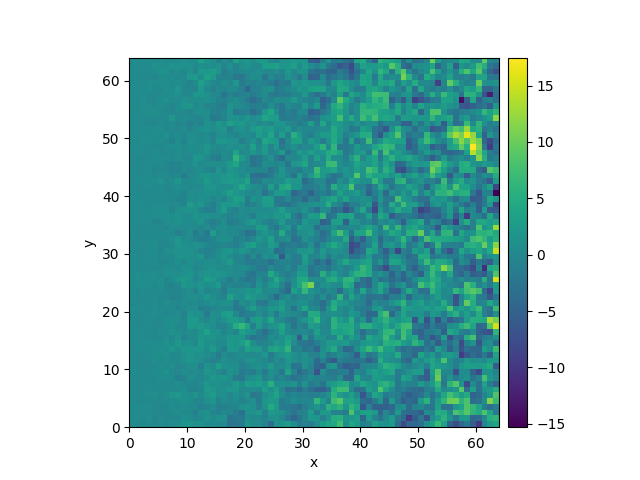
This example solves a diffusion equation with a custom noise.
  0%|          | 0/10.0 [00:00<?, ?it/s]
Initializing:   0%|          | 0/10.0 [00:00<?, ?it/s]
  0%|          | 0/10.0 [00:00<?, ?it/s]
  3%|▎         | 0.29/10.0 [00:00<00:04,  2.20it/s]
 11%|█         | 1.07/10.0 [00:00<00:01,  6.53it/s]
 54%|█████▍    | 5.43/10.0 [00:00<00:00, 15.86it/s]
 54%|█████▍    | 5.43/10.0 [00:00<00:00, 10.32it/s]
100%|██████████| 10.0/10.0 [00:00<00:00, 19.01it/s]
100%|██████████| 10.0/10.0 [00:00<00:00, 19.00it/s]
import numpy as np
from numba import jit

from pde import DiffusionPDE, ScalarField, UnitGrid


class DiffusionCustomNoisePDE(DiffusionPDE):
    """Diffusion PDE with custom noise implementations."""

    def noise_realization(self, state, t):
        """Numpy implementation of spatially-dependent noise."""
        noise_field = ScalarField.random_uniform(state.grid, -self.noise, self.noise)
        return state.grid.cell_coords[..., 0] * noise_field

    def make_noise_realization_numba(self, state):
        """Numba implementation of spatially-dependent noise."""
        noise = float(self.noise)
        x_values = state.grid.cell_coords[..., 0]

        @jit
        def noise_realization(state_data, t):
            return x_values * np.random.uniform(-noise, noise, size=state_data.shape)  # noqa: NPY002

        return noise_realization


eq = DiffusionCustomNoisePDE(diffusivity=0.1, noise=0.1)  # define the pde
state = ScalarField.random_uniform(UnitGrid([64, 64]))  # generate initial condition
result = eq.solve(state, t_range=10, dt=0.01)
result.plot()
Total running time of the script: (0 minutes 0.603 seconds)