Note
Go to the end to download the full example code.
2.2.4 Kuramoto-Sivashinsky - Using PDE class
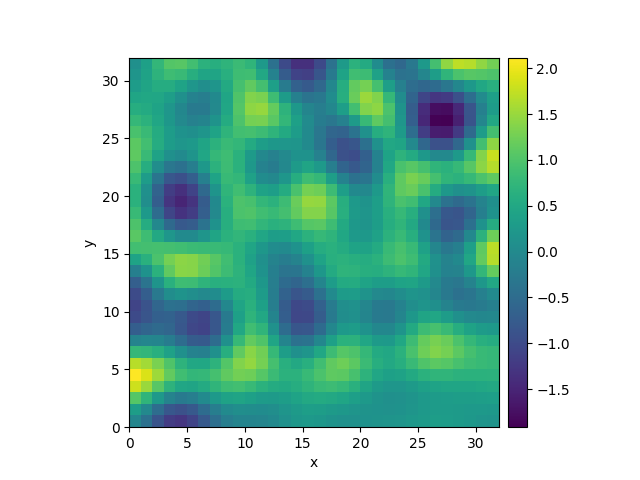
This example implements a scalar PDE using the PDE. We here
consider the Kuramoto–Sivashinsky equation, which for instance
describes the dynamics of flame fronts:
\[\partial_t u = -\frac12 |\nabla u|^2 - \nabla^2 u - \nabla^4 u\]
  0%|          | 0/10.0 [00:00<?, ?it/s]
Initializing:   0%|          | 0/10.0 [00:00<?, ?it/s]
  0%|          | 0/10.0 [00:27<?, ?it/s]
  0%|          | 0.01/10.0 [00:51<14:22:32, 5180.40s/it]
  0%|          | 0.02/10.0 [00:51<7:10:50, 2590.22s/it]
  1%|▏         | 0.14/10.0 [00:51<1:00:48, 370.03s/it]
 81%|████████  | 8.07/10.0 [00:51<00:12,  6.42s/it]
 81%|████████  | 8.07/10.0 [00:51<00:12,  6.42s/it]
100%|██████████| 10.0/10.0 [00:51<00:00,  5.18s/it]
100%|██████████| 10.0/10.0 [00:51<00:00,  5.18s/it]
from pde import PDE, ScalarField, UnitGrid

grid = UnitGrid([32, 32])  # generate grid
state = ScalarField.random_uniform(grid)  # generate initial condition

eq = PDE({"u": "-gradient_squared(u) / 2 - laplace(u + laplace(u))"})  # define the pde
result = eq.solve(state, t_range=10, dt=0.01)
result.plot()
Total running time of the script: (0 minutes 51.891 seconds)