Note
Go to the end to download the full example code.
2.4.1 Post-step hook function
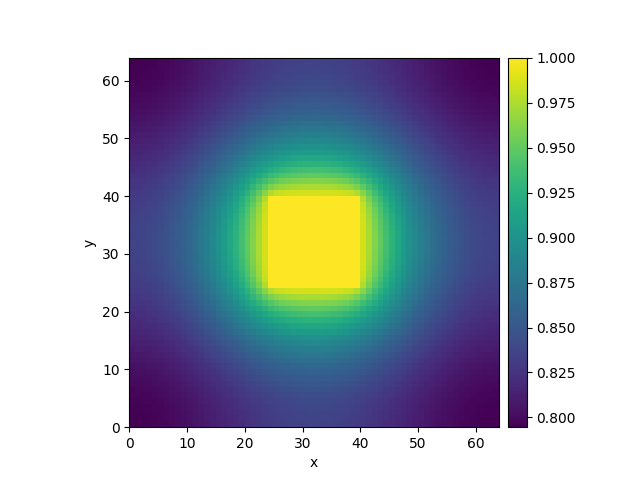
Demonstrate the simple hook function in PDE, which is called after
each time step and may modify the state and abort the simulation.
  0%|          | 0/10000.0 [00:00<?, ?it/s]
Initializing:   0%|          | 0/10000.0 [00:00<?, ?it/s]
  0%|          | 0/10000.0 [00:17<?, ?it/s]
  0%|          | 0.1/10000.0 [00:27<755:36:21, 272.02s/it]
  0%|          | 0.2/10000.0 [00:27<377:48:15, 136.01s/it]
  0%|          | 0.3/10000.0 [00:27<251:52:06, 90.68s/it]
  0%|          | 10.7/10000.0 [00:27<7:03:16,  2.54s/it]
  3%|▎         | 313.6/10000.0 [00:27<14:01, 11.51it/s]
  3%|▎         | 313.6/10000.0 [00:27<14:03, 11.49it/s]
  3%|▎         | 313.6/10000.0 [00:27<14:03, 11.48it/s]
from pde import PDE, ScalarField, UnitGrid


def post_step_hook(state_data, t):
    """Helper function called after every time step."""
    state_data[24:40, 24:40] = 1  # set central region to given value

    if t > 1e3:
        raise StopIteration  # abort simulation at given time


eq = PDE({"c": "laplace(c)"}, post_step_hook=post_step_hook)
state = ScalarField(UnitGrid([64, 64]))
result = eq.solve(state, dt=0.1, t_range=1e4)
result.plot()
Total running time of the script: (0 minutes 27.400 seconds)